Anatomy of an AI System
Demystifying how a Large Language Model works operationally. Discover the core training loops, forward-pass inference channels, and computational resource dynamics that power the bleeding edge.
Training (Learning)
The model consumes vast, unstructured corpuses of text, iteratively calculates gradients via backpropagation, and adjusts its internal parameters (weights) to minimize next-token prediction loss.
Inference (Thinking)
The model's weights are frozen (static). It accepts a context prompt (input), executes a forward-pass-only mathematical routing, and generates probability distributions over the vocabulary to output a single token.
🔄 The 11-Step LLM Training & Parameter Loop
How an LLM scales from raw Internet data to a pre-trained, high-impact cognitive predictor
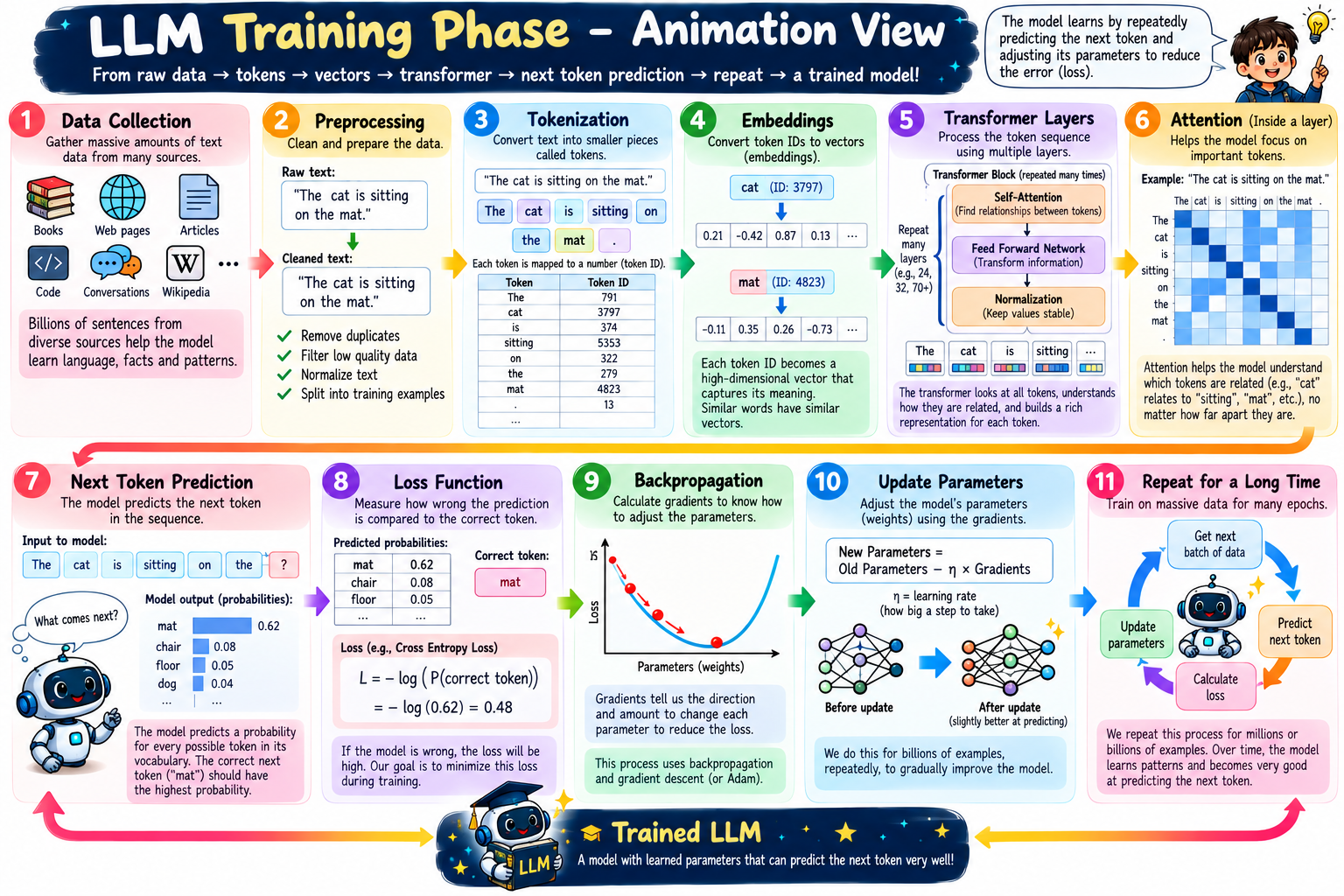
01 Data Collection
Gathering massive datasets (billions of sentences) from diverse sources like books, Wikipedia, articles, conversation logs, and repositories to teach the model vocabulary, facts, and code patterns.
02 Preprocessing
Cleaning raw data. Removing duplicates, filtering out low-quality sequences, normalizing text encodings, and splitting files into standardized training segments.
03 Tokenization
Converting clean text strings into discrete, numeric subwords (Tokens) and assigning them distinct indices (Token IDs) in the pre-trained dictionary lookup table.
04 Embeddings
Mapping Token IDs to dense, learned, high-dimensional floating-point vectors. This is the geometric space where word meanings and semantic neighborhoods live.
05 Transformer Layers
Routing embeddings sequentially through multiple stacked blocks consisting of Self-Attention, Feed Forward neural expansions, and Normalization layers.
06 Attention Block
The core engine enabling tokens to compute pairwise relational matrices to assign importance, building context-aware dynamic embeddings across long contextual spans.
07 Next Token Prediction
Performing a forward pass where the model receives prompt tokens and generates raw unnormalized confidence values (logits) over every possible word in the vocabulary.
08 Loss Function
Measuring the prediction error. Comparing predicted logits against the correct target word using Cross Entropy Loss to calculate exactly how wrong the model is.
09 Backpropagation
Propagating the calculated loss backward through the layers of the model using calculus chain rules to determine the exact gradients of every individual model parameter.
10 Update Parameters
Applying optimizers (like AdamW) to subtract gradients multiplied by the learning rate from the parameters, shifting the model's weights to make better future predictions.
11 Repeat & Trained LLM
Repeating steps 7–10 over billions of sequences across multiple training epochs. Over time, loss drops, and the model emerges as a highly capable pre-trained LLM.
⚡ Transformer Architecture: From Tokens to Context
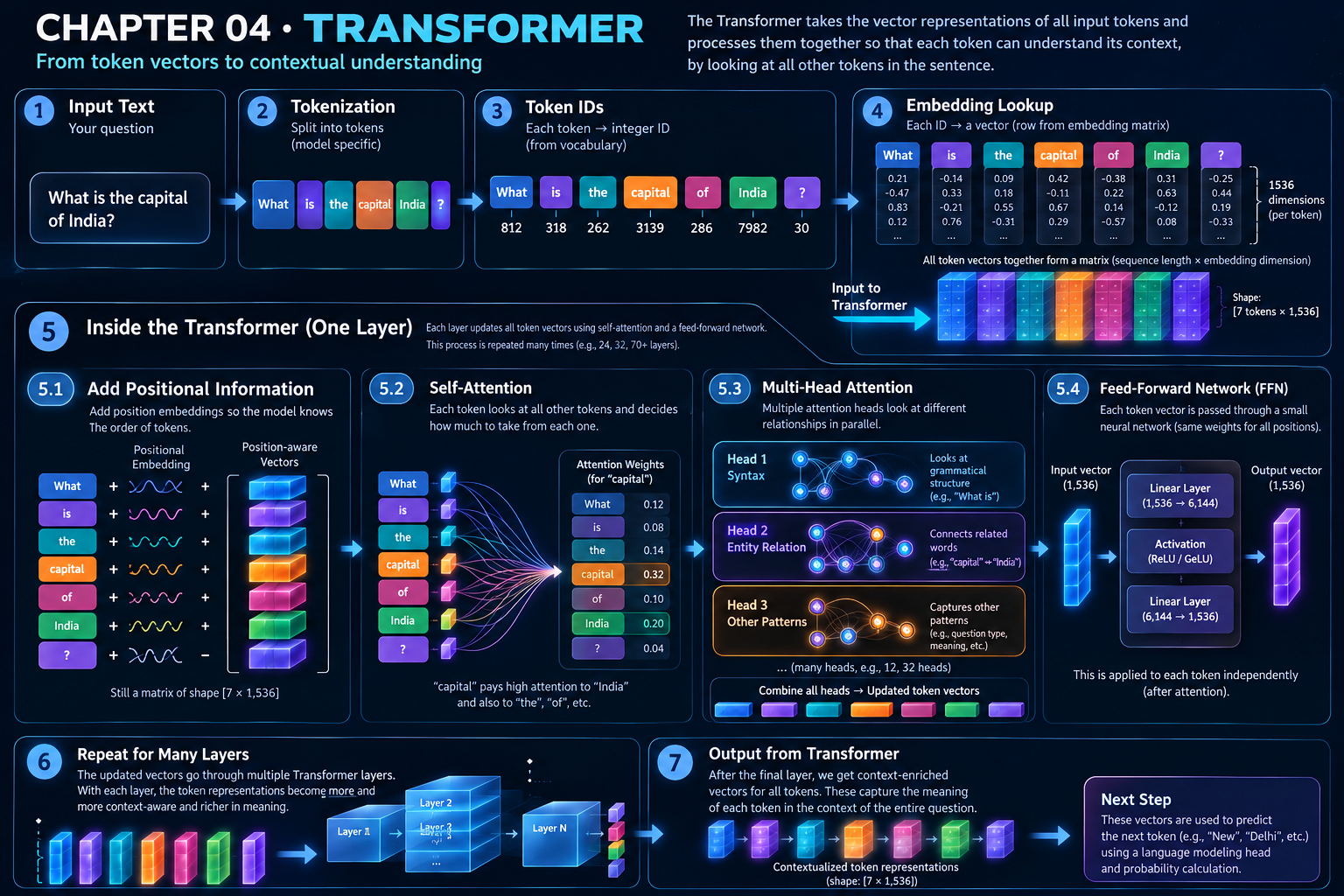
How the neural engine converts isolated token vectors into unified, context-aware representations
🗺️ The 3-Act AI Inference Journey in Your Curriculum
The Math & Forward Pass
How a model processes raw inputs to produce a single next-token probability distribution (Logits). Handled in mathematical foundations.
Explore Area 03 →Autoregressive Decoding
How a model strings generated outputs together sequentially, controlling creativity with temperature, Top-K, and nucleus sampling.
Explore Area 04 →Systems Optimization
How we scale the generation loop using KV Caching, Continuous Batching, and Quantization to run fast and cheap in production.
Explore Area 07 →