
📏 Embedding Dimensions
1. What does dimension mean?
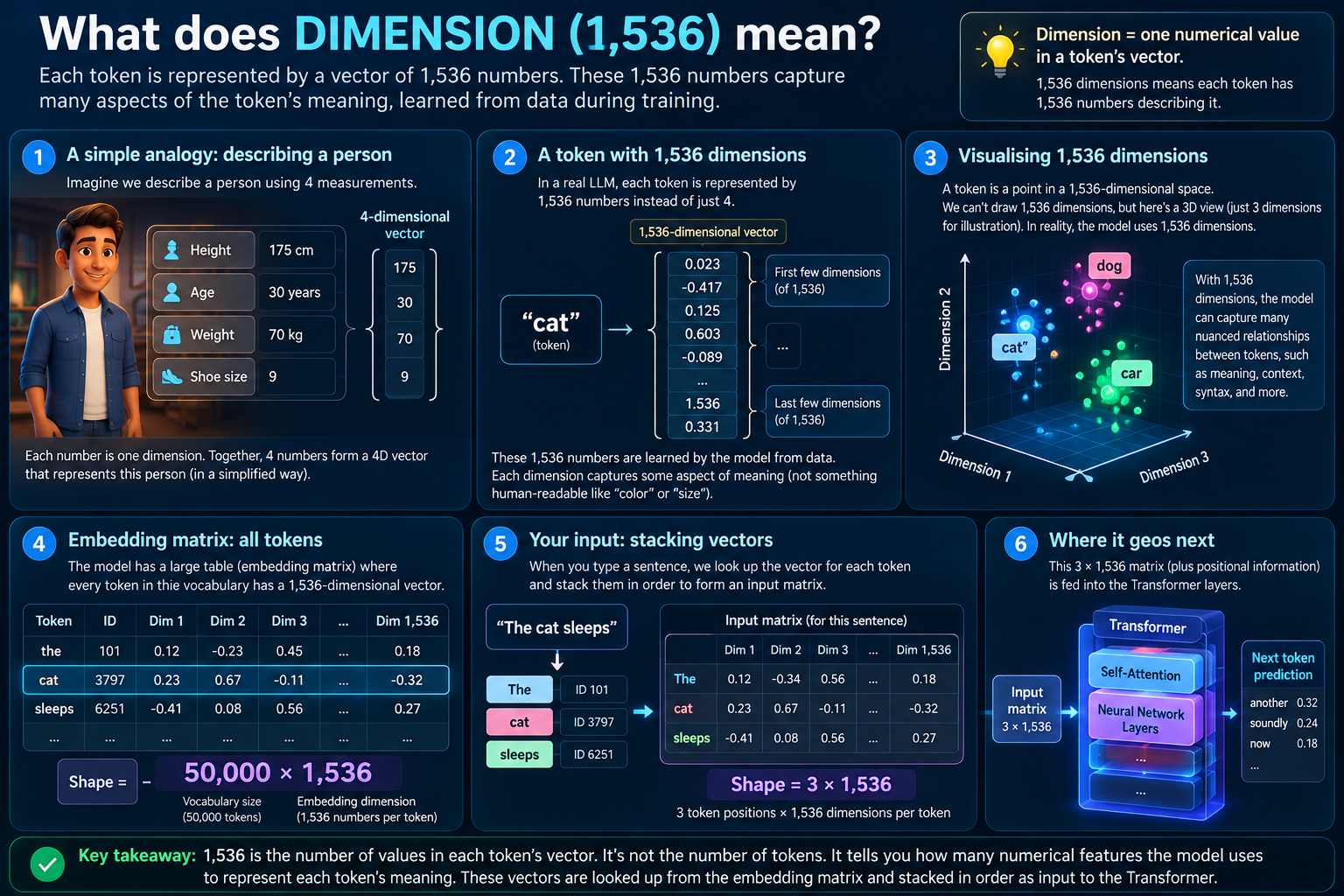
Infographic: What does Dimension (1,536) mean? Person analogy → 1,536D vector → 3D space → Embedding matrix. Click to open full size.
Example:
cat → [0.12, -0.44, 0.91, ...]
If that list has:
- 4 numbers → 4-dimensional vector
- 128 numbers → 128-dimensional vector
- 768 numbers → 768-dimensional vector
So dimension is simply:
how many numeric features the vector contains
2. Why not just use 2 or 3 dimensions?
Because language is complex.
A tiny vector cannot capture enough useful distinctions.
The model needs room to represent patterns like:
- syntax
- semantics
- topic
- style
- associations
- context interactions
Higher dimensions give the model more representational capacity.
3. Why do numbers like 768 appear so often?
There is no magical universal number.
Values like 768, 1024, or 4096 are design choices.
They usually come from:
- model architecture design
- hidden size choices
- compute budget
- memory limits
- training goals
For example:
- BERT-base uses 768 hidden size
- larger models often use larger dimensions
- smaller efficient models may use smaller dimensions
So:
embedding dimension ≠ law of nature
embedding dimension = architecture choice
4. Bigger is not always better
A larger embedding dimension can help represent more detail.
But it also increases:
- memory usage
- compute cost
- training cost
- risk of over-parameterization
So model designers balance:
- expressiveness
- efficiency
- scale
5. Important connection: embedding size and model size
In many transformer models, token embeddings are tied closely to the model hidden size.
That means the embedding dimension often matches the size used throughout later layers.
This is one reason dimension choices matter so much: they affect the whole architecture, not just the input layer.
This becomes more important when you study:
6. Practical intuition
Think of embedding dimensions like the number of coordinates used to place a token in a learned meaning space.
Too few coordinates:
- not enough expressive power
Too many coordinates:
- expensive and sometimes unnecessary
The right size depends on the model’s goals.
7. Common misunderstanding
Do not think:
dimension 1 = gender
dimension 2 = size
dimension 3 = emotion
Sometimes individual dimensions may correlate with patterns, but embeddings are usually distributed representations.
Meaning is spread across many dimensions together.
That is why embeddings are powerful but not directly human-readable.