
Embedding Matrix
Understand the embedding matrix as a learned table: one row per vocabulary entry, with the token ID as the row index that selects a vector.
The Embedding Matrix: A Cabinet of Numbered Drawers
The scholar keeps one drawer for every entry in the vocabulary. The drawer number is the token ID; what is inside is a card of learned numbers. Opening a drawer is a lookup. Training is the scholar rewriting the cards in the drawers that were used.
IntroductionWhat is the embedding matrix?
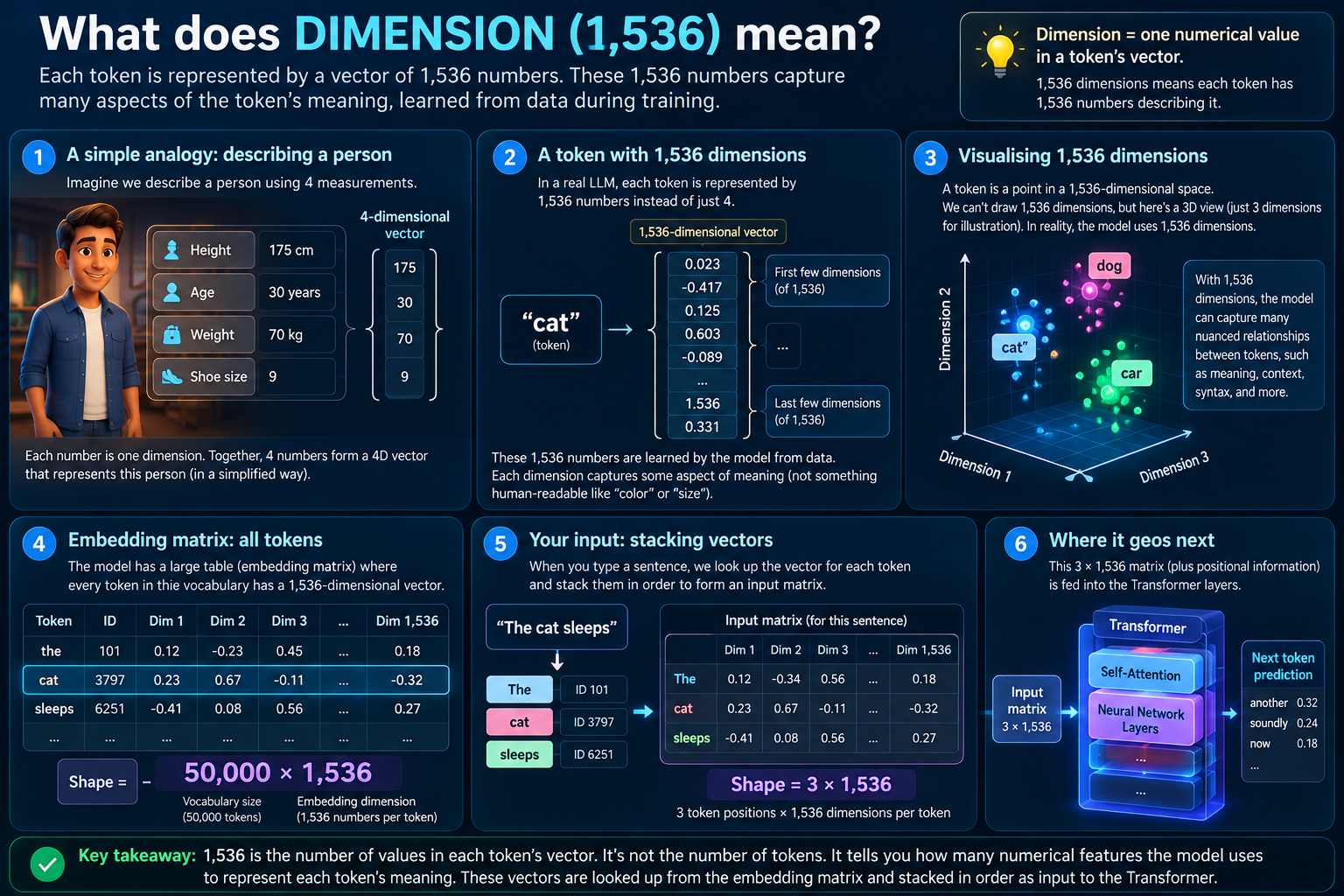
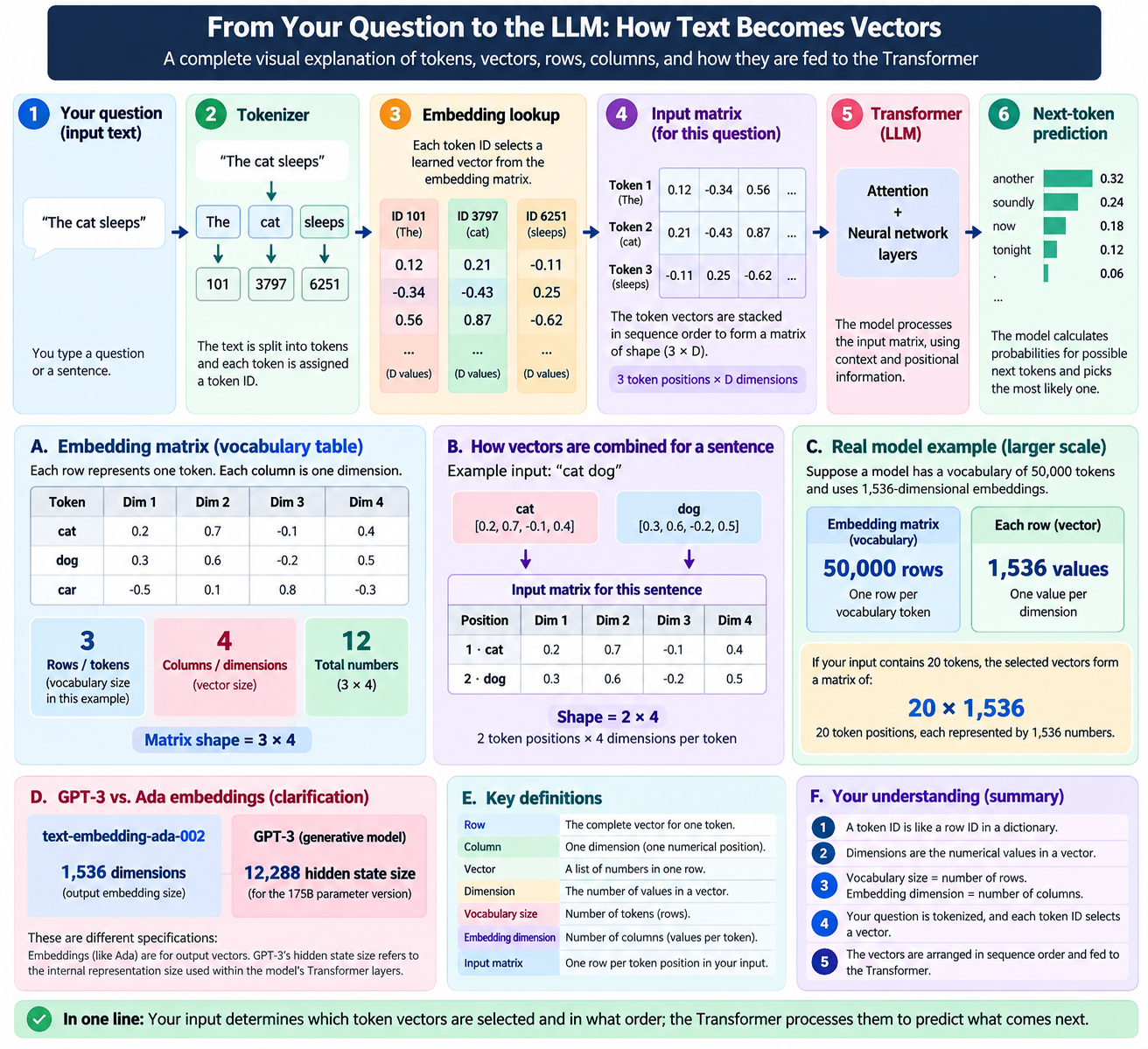
"If a token ID is just a number, where does the model actually keep what it has learned about each word?"
In a big table of numbers called the embedding matrix. It has one row for each entry in the vocabulary, and the token ID tells the model which row to read.
1, the model reads row 1 and gets back that token's list of numbers. Training adjusts those numbers; nothing else about the table changes.
The embedding matrix E is a learned table with shape [V, D]: V rows (one per vocabulary entry, usually) and D columns (the embedding dimension). A token ID selects a row; that row is the token's embedding.
💡 The embedding matrix is the model's learned lookup table. The token ID is the row index; the row is the learned content.
WhyWhy a table of learned rows?
The transformer needs numbers it can do arithmetic on, and token IDs are not those numbers (see Token Embeddings). A table solves three problems at once.
- Fast access: a token ID is a ready-made index. Reading row i needs no search.
- Learnable: every number in the table is a parameter. Training can nudge a token's row to make the model's predictions better.
- Rich representation: a row of hundreds of numbers can hold far more than a single integer.
Without a table
You would need a rule that computes a vector from a token. For a vocabulary of tens of thousands of arbitrary subwords there is no such rule to write by hand.
With a table
Each token gets its own free parameters. The model discovers useful vectors during training instead of someone designing them.
IntuitionTwo tables, one ID
A token ID works like a row ID. The same number is the key into two different tables. (Small IDs below are illustrative.)
Table 1 — Vocabulary (tokenizer)
| Token ID | Token |
|---|---|
| 0 | the |
| 1 | cat |
| 2 | dog |
| 3 | bank |
| 4 | river |
Maps token ↔ ID. the cat becomes [0, 1].
Table 2 — Embedding matrix E (model)
| Row | Vector (illustrative) |
|---|---|
| 0 | [ 0.2, 0.5, −0.1, …] |
| 1 | [ 0.8, −0.3, 0.4, …] |
| 2 | [−0.2, 0.7, 0.1, …] |
| 3 | [ 0.1, 0.6, −0.5, …] |
| 4 | [ 0.0, 0.4, −0.6, …] |
Maps ID → learned vector. ID 1 selects row 1: the vector for cat.
- The vocabulary is a dictionary-like mapping (
"cat" → 1), usually a hash map. - The embedding matrix is not a dictionary. It is a dense array indexed by position,
E[1], and stores no token strings. - They line up only through the shared number. Change the tokenizer and every ID points at the wrong row.
💡 Think of the token ID as a database row index, not as the meaning of the word. The learned vector in that row is what provides the numerical representation the transformer works with.
Is the vector stored inside the token ID?
No. For token ID 1 (cat), the matrix row is a short list of learned numbers (illustrative, 4 values):
The ID is the address; the four numbers are the vector. Here the dimension is 4. A real matrix with 50,000 tokens and 4,096 dimensions has shape 50,000 × 4,096: 50,000 rows of 4,096 numbers each. See Vector Dimensions for a slider that shows how the vector grows, and How Embeddings Are Learned for where these numbers come from.
TheoryAnatomy of E: rows, columns, and what is learned
| Part | What it is | Notes |
|---|---|---|
Rows (V) | One per vocabulary entry, usually | Some models pad the row count beyond the vocabulary size. |
Columns (D) | The embedding dimension | For example 768 for GPT-2 small and BERT-base. Individual columns generally have no human-readable meaning. |
| Entries | Learned floating-point parameters | Usually start random; adjusted by backpropagation. |
| Row i | The embedding of token i | Same row every time token i appears, in any sentence. |
What the matrix is not
- Not a dictionary of definitions. A row is a learned numeric pattern, not a stored meaning.
- Not context-aware. A row does not depend on the other tokens. Context is added later (see Contextual Embeddings).
- Not the whole model. Knowledge also lives in the transformer weights. The matrix is one set of learned parameters among several.
How It WorksLookup in the forward pass, update in training
[0, 1].2. The embedding layer reads rows
E[0] and E[1].3. The rows are stacked into a
[seq_len, D] matrix and passed on.1 appears, row 1 holds slightly different numbers.
graph LR
    A["Text: the cat"] --> B["Token IDs: 0, 1"]
    B -->|"read rows"| C["E[0], E[1]"]
    C --> D["Transformer"]
    D --> L["Loss"]
    L -->|"gradient"| C
    C -->|"optimizer updates only used rows"| E["E (slightly changed)"]

    style A fill:#3b82f6,stroke:#1d4ed8,color:#fff
    style B fill:#10b981,stroke:#047857,color:#fff
    style C fill:#8b5cf6,stroke:#6d28d9,color:#fff
    style E fill:#f59e0b,stroke:#b45309,color:#fff
CalculateA 5 × 3 matrix by hand
Use the matrix from the introduction (V = 5, D = 3). All numbers are invented for teaching.
15 learned numbers.[0, 1] give[[0.2, 0.5, −0.1], [0.8, −0.3, 0.4]] — a 2 × 3 matrix (sequence length × D).[0, 1, 0, 0, 0]. Multiplying it by E picks out row 1: [0.8, −0.3, 0.4].[0.5, −1.0, 0.2] and the learning rate is 0.1. New row 1 = [0.8 − 0.05, −0.3 + 0.10, 0.4 − 0.02] = [0.75, −0.20, 0.38]. Rows 0, 2, 3, 4 are unchanged.[1, 1]), each use contributes its gradient to the same row. With the same numbers the contributions add: new row 1 = [0.70, −0.10, 0.36].MathematicsLookup, gradient, and the output side
Lookup equals a one-hot product
Frameworks index the row directly instead of multiplying, because the one-hot vector is almost all zeros.
Why the gradient is sparse
Row $j$ contributes to the loss $\mathcal{L}$ only through the positions where the token ID equals $j$:
If token $j$ is absent from the batch, the sum is empty and the row gets zero gradient for that step.
Parameter count and the output side
Many language models reuse $\mathbf{E}$ to turn the final hidden vector $\mathbf{h}$ into scores over the vocabulary ("weight tying"): $\text{logits} = \mathbf{h}\,\mathbf{E}^{\top}$. GPT-2 does this.
VisualizeLive lookup: type tokens, see the rows
Type words from the toy vocabulary (the cat dog bank river). The lab shows their IDs, highlights the rows that get read, and stacks them into the output matrix.
| Row (ID) | Token | d0 | d1 | d2 |
|---|
CodeBuild the table, then use PyTorch
Part A — pure Python:
vocab = {"the": 0, "cat": 1, "dog": 2, "bank": 3, "river": 4}     # Table 1: token -> ID (illustrative)

E = [                                                              # Table 2: ID -> vector (illustrative)
    [ 0.2,  0.5, -0.1],
    [ 0.8, -0.3,  0.4],
    [-0.2,  0.7,  0.1],
    [ 0.1,  0.6, -0.5],
    [ 0.0,  0.4, -0.6],
]

ids = [vocab[w] for w in "the cat".split()]
print(ids)                                    # [0, 1]

X = [E[i] for i in ids]                       # the lookup
print(X)                                      # [[0.2, 0.5, -0.1], [0.8, -0.3, 0.4]]

# same thing as a one-hot product
one_hot = [0, 1, 0, 0, 0]
row = [sum(one_hot[r] * E[r][c] for r in range(5)) for c in range(3)]
print(row)                                    # [0.8, -0.3, 0.4]

# one gradient-descent step on row 1
grad, lr = [0.5, -1.0, 0.2], 0.1
E[1] = [round(E[1][c] - lr * grad[c], 3) for c in range(3)]
print(E[1])                                   # [0.75, -0.2, 0.38]
Part B — PyTorch:
import torch
import torch.nn as nn

emb = nn.Embedding(num_embeddings=5, embedding_dim=3)     # E has shape [5, 3], random start
ids = torch.tensor([0, 1])

x = emb(ids)
print(x.shape)                                             # torch.Size([2, 3])
print(torch.equal(x, emb.weight[ids]))                     # True  -> a lookup is row indexing

one_hot = torch.nn.functional.one_hot(ids, num_classes=5).float()
print(torch.allclose(one_hot @ emb.weight, x))             # True  -> same as a one-hot product

emb(torch.tensor([1, 1])).sum().backward()                 # use token 1 twice
used = (emb.weight.grad.abs().sum(dim=1) > 0).nonzero().flatten().tolist()
print(used)                                                # [1]  -> only row 1 received gradient
torch and its outputs follow from how nn.Embedding works, but they were not run for this page.ExperimentPoke a real embedding matrix
CompareVocabulary vs embedding matrix vs related tables
| Property | Vocabulary | Embedding matrix E | Output head (unembedding) | Positional embeddings |
|---|---|---|---|---|
| Maps | token ↔ ID | ID → vector | hidden vector → scores per token | position → vector (in models that use them) |
| Shape | V entries | [V, D] | [D, V] (often tied to E) | [max_len, D] |
| Learned by gradient? | No (built before training) | Yes | Yes (or shared with E) | Yes in learned schemes |
| Lives in | Tokenizer | Model | Model | Model |
| Stores token text? | Yes | No | No | No |
ApplyWhere the embedding matrix matters in practice
- Memory and size:
V × Dparameters. Doubling the vocabulary doubles this table. - Adding tokens: after adding tokens to a tokenizer, call
model.resize_token_embeddings(len(tokenizer))so each new ID has a row. New rows start untrained and need fine-tuning to become useful. - Weight tying: reusing E as the output projection saves
V × Dparameters. - Fine-tuning choices: some recipes freeze E to save memory or keep the original vocabulary behaviour; others train it, especially when new tokens are added.
- Swapping tokenizers: not possible without retraining or remapping, because rows are aligned to the original vocabulary.
LimitationsCommon mistakes and traps
nn.Embedding is random. Useful structure appears with training or by loading trained weights.Mistakes to avoid
- Mixing a tokenizer with the wrong model
- Resizing the vocabulary without resizing E
- Reading meaning from row numbers
Correct mental models
- ID = row index; row = learned content
- Vocabulary and E are two tables joined by the ID
- Only rows used in a batch get updated that step
ExplainFeynman Challenge: the spreadsheet
The embedding matrix is a spreadsheet with one row per vocabulary entry. The token ID is the row number. The cells are numbers the model learned. To "read a word", the model looks up its row and takes the numbers it finds there.
Try explaining this to someone right now: "What is the difference between the vocabulary and the embedding matrix, and how does a token ID connect them?"
🚫 Common Misconceptions to Correct
- Misconception: the vocabulary and the embedding matrix are one thing.
Reality: The vocabulary belongs to the tokenizer; the matrix belongs to the model. The ID joins them. - Misconception: the lookup learns.
Reality: The lookup only reads. Learning happens when the optimizer updates the rows during training. - Misconception: the matrix is the model's whole knowledge.
Reality: The transformer weights hold a large part of it too.
BuildMini-project and summary
🎯 Four Things to Build for Mastery
1 — Embedding layer class
Write Embedding(V, D) with forward(ids) using plain lists. Add a method that returns the parameter count.
2 — Sparse updater
Implement step(ids, grads, lr) that updates only the rows in ids, summing gradients for repeated IDs. Test it with the Calculate phase numbers.
3 — Size calculator
Given V, D and bytes per value, print the parameters and memory. Reproduce the GPT-2 small figures.
4 — Resize experiment
Add tokens to a tokenizer, resize a model's embeddings, and inspect the new rows against the old ones.
📌 Summary — Everything in Six Bullets
- E is a learned table of shape
[V, D]: one row per vocabulary entry, usually. - The token ID is the row index. It is a key, not a meaning.
- Two tables, one ID. The vocabulary maps tokens to IDs; E maps IDs to vectors.
- Lookup reads, training writes. Only rows used in a batch receive gradient.
- Geometry carries meaning. Closeness of vectors matters; closeness of row numbers does not.
- Pipeline: Text → Token ID → Embedding matrix row → Vector → Transformer.