Q × K
How Query Meets Key ($Q \cdot K^T$) to Calculate Attention Scores
Observe step 4 below: The Query vector for 'capital' is compared against all token Keys via dot product, scoring highest for 'India' ($0.36$) and itself ($0.41$).
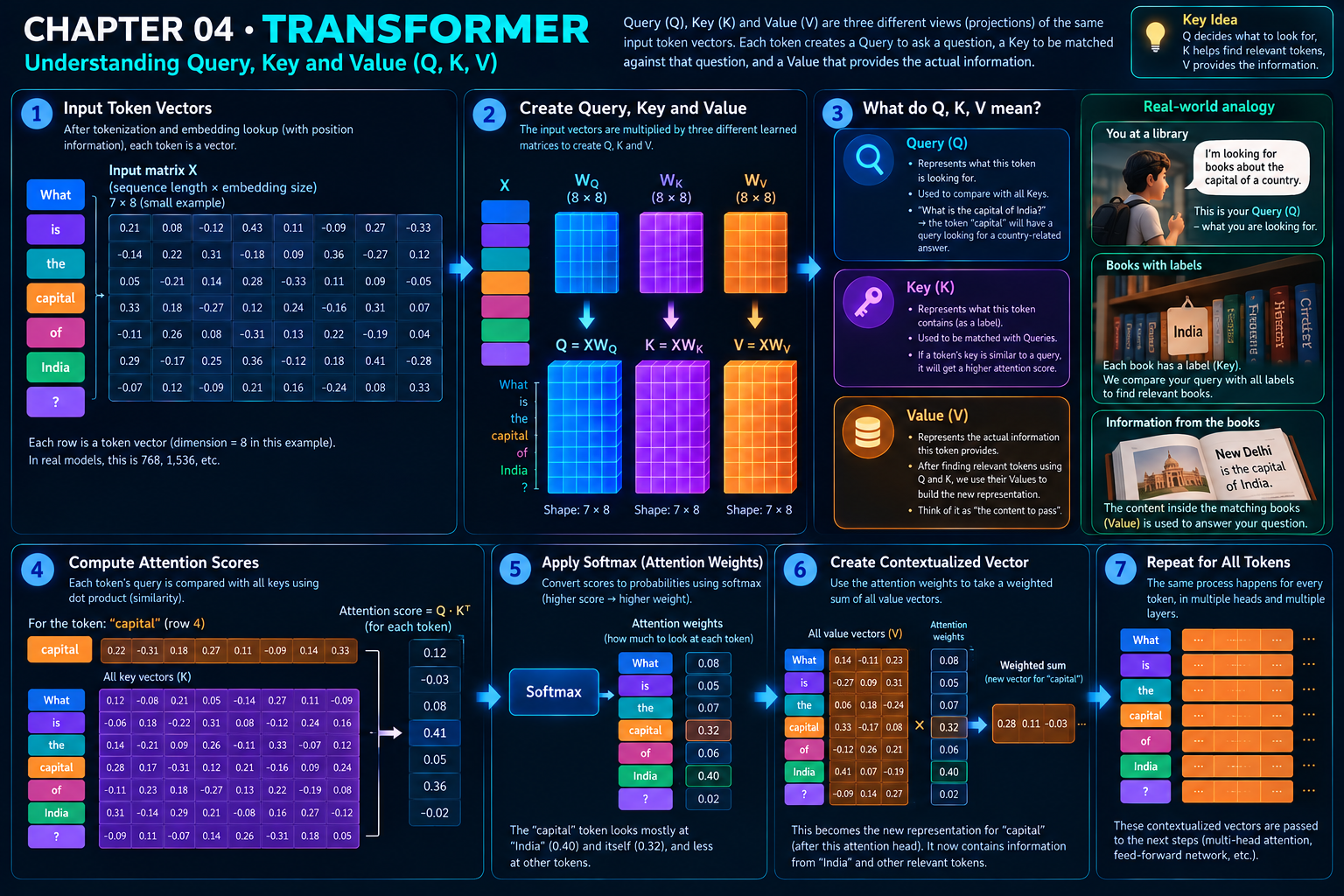
What is Q × K? Why does it exist? Where does it appear in QKV?
Draw or describe a visual model of Q × K. What does it look like conceptually?
Work through a concrete manual example of Q × K with real numbers or pseudocode.
Implement Q × K from scratch in Python. Keep it minimal — just enough to see it work.
Try Q × K on a real example. Vary the inputs and observe what changes.
How is Q × K different from related concepts in QKV? What are the trade-offs?
Explain Q × K in plain language using an analogy. Could a non-expert follow it?
Build a small project or demo that uses Q × K as a core component.
🔨 M-05 attention.py 🔁 Q/K/V intuition → verifier scoring → return to
agent/verifier.py
📋 full plan →